
I’ve seen countless fitness apps launch with hype and fade out within 90 days, and the pattern is almost identical every time.
After working closely with multiple fitness-tech founders, I have observed one key point: 72% of users quit because the app doesn’t understand what workout they actually need.
Fitbod delivered a solution, not with fancy UI, but with AI that thinks like a personal coach, adjusting workouts based on fatigue, muscle balance, progress, and available equipment.
The result?
✔ 100K+ downloads. Not luck. Intelligence.
✔ Top retention rates. Users stay because AI adapts.
✔ Premium pricing. People pay for personalization.
✔ Real coaching. Without the $200/hour price tag.
In this guide, I break down exactly what it takes to build an AI-powered workout app like Fitbod in 2026, including the real development cost, tech stack, essential features, hidden expenses, and the smartest launch plan to build an AI fitness app like Fitbod the right way in 2026.
Fitbod: The AI Fitness Game-Changer
Most beginners don’t struggle because of motivation; they struggle because they don’t know what to do, how much, or when. This used to be the major hurdle in the fitness sector until AI changed the overall scenario.
Fitbod did it in 2015 by introducing an AI-powered fitness app that doesn’t just show exercises, it acts like an active smart coach, adjusting routines based on progress, recovery, and equipment.
In short, Fitbod didn’t digitalize fitness, but it personalized it.
Going ahead and we will now see the important features of an AI-powered fitness app like Fitbod.
Essential Features of AI-Powered Fitness Apps Like Fitbod
In applications, features are the important pillars to focus on. These are the elements developers should adapt when planning AI app development for a Fitbod-like product.
| Features | What It Does |
| AI-Powered Personalized Workouts | Generates custom routines using training history, recovery, and fitness level; adapts in real-time for progress. |
| Non-Linear Periodization | Varies in intensity, sets, and reps based on goals and performance data for optimal results. |
| Comprehensive Exercise Library | Multi-angle videos, expert instructions, and filters by muscle, equipment, or condition. |
| Progress Tracking & Analytics | Tracks performance, personal records, consistency, and integrates wearable data |
| Custom Routine Builder | Save workouts, apply modifiers like supersets, and get AI suggestions |
| Wearable & Health Integration | Syncs with devices like Apple Watch and Google Fit to monitor calories, heart rate, and activity. |
These features put Fitbod-like apps as leaders, with market growth at 23.1% CAGR to $23.35 by 2030. Essential for similar apps like Fitbod: AI adaptation, vast library, and integrations enhance user satisfaction and monetization
Technology Stack for Building a Fitbod-Like App
Want to know what goes into the tech behind a Fitbod-style app?
Below is an overview of the key technologies typically used to build such a platform:
1. Frontend Development
Why It Matters?
In the AI fitness app market, a good visual frontend is needed to stay competitive.
For technology,
Choose-> React Native or Flutter
Choose-> Cross-platform apps, or Swift for complete native performance.
2. Backend Development
For a stronger database of your app so that it works smoothly, choose databases such as PostgreSQL, MongoDB, and a more reliable one.
Any leading fitness app development company prioritizes a high-performance backend to avoid lags, crashes, and bottlenecks.
3. AI / Machine Learning Stack
Every user’s decision in apps is mostly driven by personalization. It is powered by AI tools like PyTorch, OpenC,V and more.
Such type of technologies properly analyze, for example, muscle usage and possible injury risks, to create smarter workout plans daily.
4. Cloud Infrastructure
In today’s digital world, everything is saved on cloud data. Most of the apps store their data on different cloud servers, such a Google Cloud, AWS, Azure, for handling computing, whereas S3/Cloud storage and CDN provide media quickly.
Due to this, you get faster video playback, a smooth coaching guide, and even during the time of peak period.
5. DevOps, CI/CD & Automation
Updates are crucial and must be rolled out in your app without any crashes. But, is it possible?
Yes, through Docker + Kubernetes, orchestrate services, while for faster deployment, use GitLab CI/CD to automate so that releases are faster and more secure.
6. Real-Time Communication & Sync
In an app, leaderboards, reminders, and other critical information must sync faster without any delay. WebSockets, gRPC, and Kafka handle live updates, while FCM and Apple Push keep notifications timely and relevant.
7. Security & Compliance Layer
Users’ crucial information is stored in apps, which can be compromised due to the risk of data theft, by any medium.
Fitness data should be well secured through the use of JWT, SES-256 encryption and TLS 1.3 to protect users’ identity and history.
8. Analytics & Personalization Engine
User engagement is essential, and how will you check whether your users are coming back or not?
Red/shift, Snowflake, and BigQuery can be utilized to store long-term user behaviour can be used to check user retention.
Breaking Down AI Fitness App Development Costs
To build a fitness app like Fitbod, investment is needed for massive scale.
Beneath, I will show you the detailed breakdown of the cost affecting your development goals:
1. Basic Fitness App- $10,000 to $45,000
- Focuses mainly on features like user registration, goal setting, and workout tracking.
- Good for MVP launch to test the market
2. Mid-Range Fitness App- $50,000 to $80,000
- Add up personalized workout plans
- Integrates with wearables such as Fitbit and Apple Watch
3. Advanced AI Fitness App- $90,000 to $150,000+
- Offers AI-driven coaching and smart workout suggestions
- Supports live streaming workouts and AR/VR experiences
Quick cost comparison
Here is the quick comparison guide:
| Version | Cost Range | Best For |
| MVP Fitness App (Non-AI) – Basic version | $10,000 – $45,000 | Testing demand quickly |
| Mid-Level AI Fitness App | $50,000 – $80,000 | Wearables + analytics + basic AI coaching |
| Advanced Fitbod-Level AI App | $90,000 – $150,000+ | Smart training engine + scalable cloud |
Development Team & Location
The app development of your AI fitness app also relies on the region where you are hiring developers or an expert team. Here is the quick comparison guide:
| Country | Average Hourly Rate | Impact on Final Software Cost (Fitness App Development) |
| USA | $90 – $150/hr | Drives the highest budget due to senior AI/ML talent and fast delivery |
| UK | $70 – $120/hr | Premium pricing for high-security builds |
| India | < 25/hr | Most cost-efficient without compromising quality; perfect for startups building AI fitness apps with a wider feature scope |
| Germany | $80 – $135/hr | Higher cost but reliable for precision engineering |
| Canada | $75 – $125/hr | Strong for enterprise-grade development; suitable for fitness apps requiring cloud scalability |
| Australia | $70 – $120/hr | Balanced cost-to-quality ratio; good for mid-to-large AI fitness apps |
Key Note: Selecting the right development location can make the difference between a limited MVP and an AI app with advanced features that expand quickly. This is why partnering with the right Fitness App Development Company becomes crucial for managing cost, quality, and better growth potential.
Top 10 Critical Factors That Drive AI Fitness App Development Costs
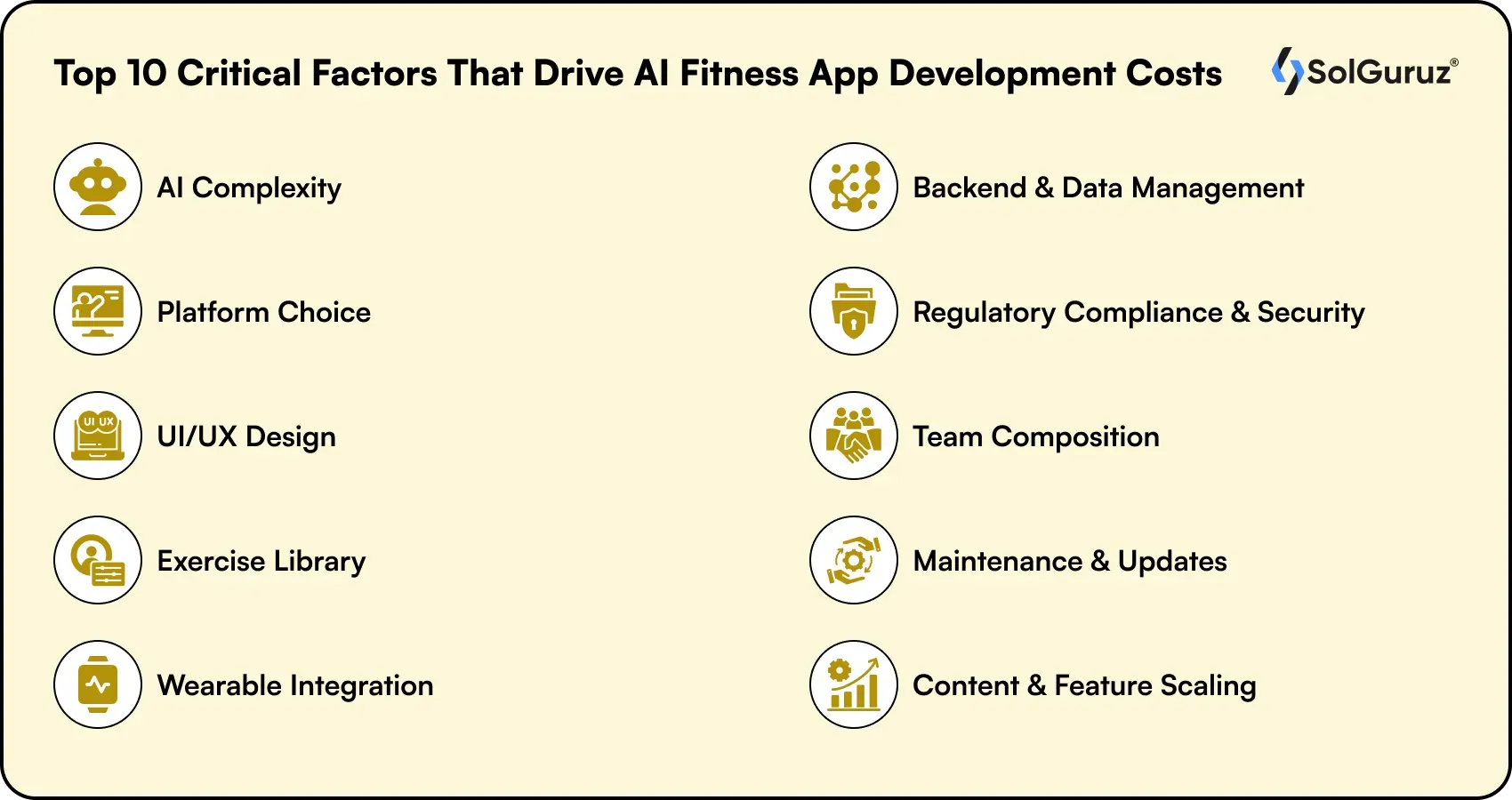
The cost of building an AI fitness app depends on multiple factors and data-driven decisions.
Here are the key factors that influence AI fitness app costs:
1. AI Complexity
Simple rule-based recommendations will cost you less. Deep-learning personalization with continuous optimization costs more.
2. Platform Choice
Cross-platform apps save money. Native apps deliver better performance but require separate builds.
3. UI/UX Design
Smooth, engaging, and accessible design boosts retention. Quality design enhances development costs.
4. Exercise Library
High-quality videos, multiple angles, and expert content build trust. Larger libraries need more investment.
5. Wearable Integration
Syncing with devices like Apple Watch and Fitbit is key for users. Every device needs constant updates.
6. Backend & Data Management
Secured databases, analytics, and real-time sync are essential. Robust infrastructure levels up the costs.
7. Regulatory Compliance & Security
GDPR, HIPAA, and data protection are mandatory. Compliance work adds to expenses.
8. Team Composition
US-based experts cost more. Offshore or hybrid teams can reduce costs without compromising quality.
9. Maintenance & Updates
Yes, continuous maintenance and updates will lead to additional costs. Regular improvements are important as user patterns change.
10. Content & Feature Scaling
Adding new exercises, AI improvements, or gamification boosts value. More add-on features lead to more cost.
8-Step Development Roadmap for Your AI Fitness App
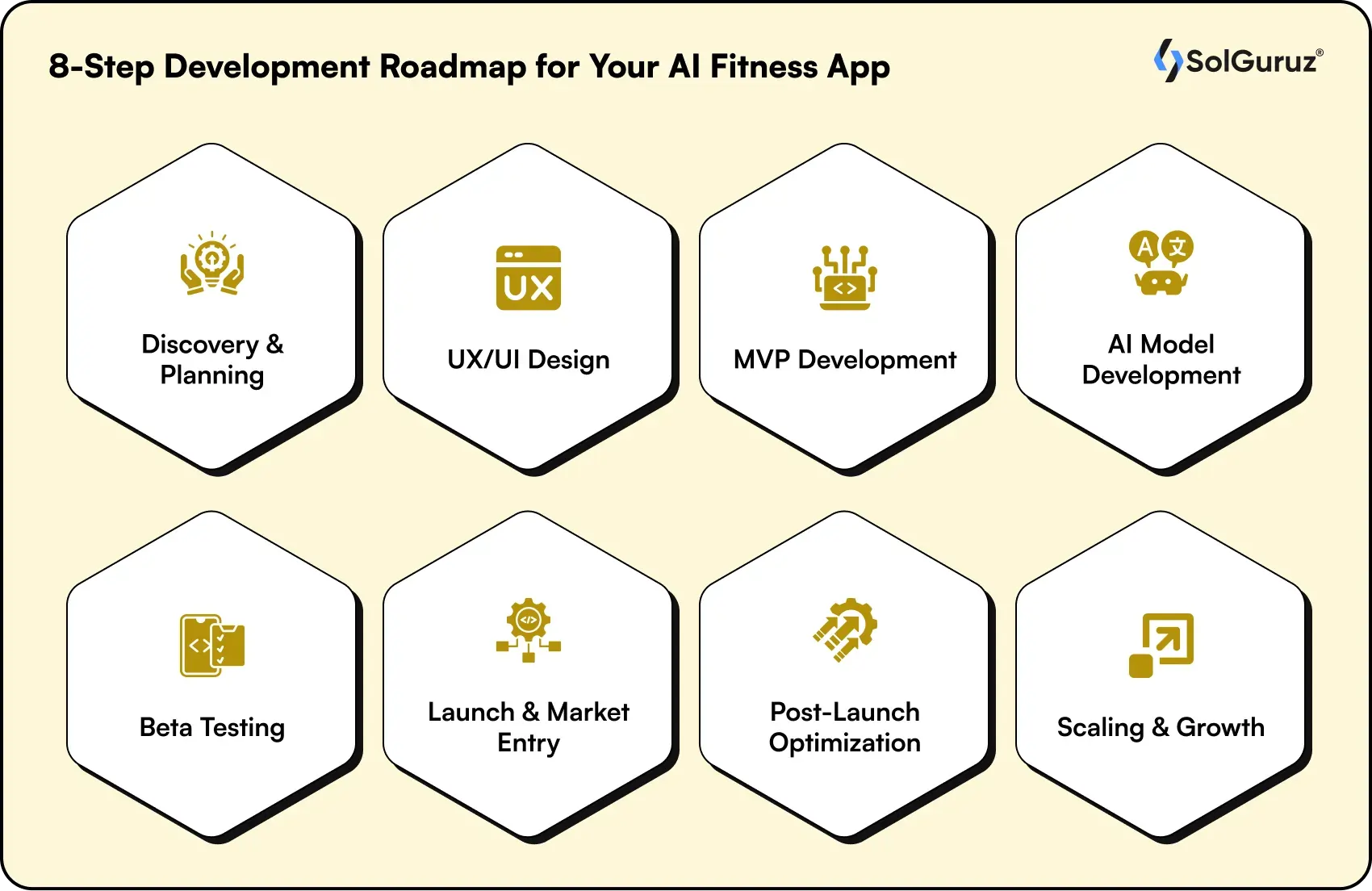
Do you really know the right roadmap to follow for your AI fitness app? If not, here is the process we follow:
1) Discovery & Planning
At the initial stage,
- Get a blueprint and proper planning of the ideas for your app.
- Clear the key points: what problem the app will solve user audience, technology to be used.
2) UX/UI Design
- A well-designed interface is key to keeping users engaged.
- Test layout functionality via wireframes and prototype
3) MVP Development
- An important phase where the ideas are being transformed into a functional product.
- The MVP includes the most impactful features, onboarding, AI-driven workouts, exercise library, progress tracking, and performance insights.
4) AI Model Development
- AI models have become crucial with the advancement of technology.
- These models are trained at an advanced scale, offering users personalized workout sessions.
5) Beta Testing
It assists in:
- Analyzing errors and identifying bugs
- Making the deployment process smoother and bug-free.
6) Launch & Market Entry
- Launching the app should be done on a large scale so that it creates a longer impact.
- App stores are optimized, market resources and media are rolled out.
7) Post-Launch Optimization
- Launching is the starting point of scaling.
- Here in this phase, user behaviour pattern is analyzed, tracked, and the accuracy level of AI is improved, and new features are focused on for better engagement analysis.
8) Scaling & Growth
- After the product market is proven to be fit, scaling is boosted further with advanced strategic approaches.
- Multiplatform devices, offering premium features, and an expanding team that pushes the app toward enterprise-level revenue.
Monetization Models for an AI Workout App Like Fitbod
If you’re researching how Fitbod makes money, the answer is in its strategic mix of multiple monetization streams instead of relying on a single revenue source.
Apps nowadays are aiming towards adapting to different modernization models with the aim of generating revenue.
Let’s explore the key models.
1. Freemium
In this, users can try basic features and try a few workouts each week, follow some basic routines, and track their progress without spending time.
2. In-App Purchases
Users pay only for features which are genuinely usable to them.
Many users only pay for those features they really need instead of going for subscriptions.
For example, someone might purchase a 30-day strength challenge after reaching a plateau or unlock advanced nutrition planning when focusing on their diet. This method allows users control over the features that matter most.
3. Premium Subscriptions
This is where Fitbod really makes its money, and honestly, it’s where the app stops being just another workout tracker.
Premium members get the complete package with unlimited workouts that actually adapt based on users’ behaviour, detailed analytics that sync with their Apple Watch or Fitbit, and meal plans that match their training goals.
And if you are aiming to develop a fitness platform with the same profitability potential, then Hire Mobile App Developers who excel in AI-driven workout app development.
Ready to Launch? Partner With Experts Who’ve Done This Before
Building an AI fitness app like Fitbod isn’t easy; it’s a proper roadmap and execution that delivers profitable results.
$50K gets you started, $200K makes you competitive, $500K can build a category leader.
Most apps fail within 90 days because founders select the team without real AI experience.
The AI fitness market is rising, and it is projected to reach $46.1 billion by 2034, and users demand apps that adapt and coach smartly.
This is where SolGuruz becomes a key advantage.
What you get:
- Experienced Technical Team- Yes
- Flexible Meetings- Yes
- Trustable and transparent communication- Yes
- Faster time to market- Yes
From the first technical discussion to watching your metrics climb months after launch, we’re focused on building something that lasts.
FAQs
1. What is the cost of developing an AI fitness app like Fitbod in 2026?
The cost of developing an app can be different depending on the features. For example, an app with advanced features will cost you between $90,000 – $150,000. And, the basic version of the similar app could $10,000 – $45,000.
2. How much time does it take to build an AI-powered fitness app from start to launch?
The timeline depends on the type of app you want. From the starting phase to the release, the process mostly takes around 6 - 12 months. Factors such as functionality, design detail, and the efficiency of testing cycles affect the timeline.
3. Can startups afford to build AI fitness apps, or is it only for big companies?
Yes, startups can easily afford to build AI fitness apps. If you are a startup company, begin with an MVP version that costs you approximately $40000. Once done, scale up with advanced features. Many successful fitness apps started as lean MVPs before turning into robust platforms.
4. What's the difference between traditional fitness apps and AI-powered apps?
Static workout libraries are being provided by traditional apps, whereas AI-powered apps provide real-time workouts that are based on user progress and goals. AI-powered apps utilize machine learning to learn from data and create dynamic training plans.
5. Do I need to collect my own training data to build an AI fitness app?
Most projects land somewhere in the 6-12 month range, though that timeline shifts based on your team's experience and how ambitious your feature set is. You're looking at several weeks just for research and planning, another few months for design and user testing, then the bulk of time goes into actually building out the recommendation engine.