
Walk into any hospital today, and you’ll find two realities living under the same roof.
In one room, clinicians are using advanced imaging systems and remote patient monitoring sensors that can flag a cardiac risk before symptoms even surface.
In the very next room, a nurse is waiting for a slow, outdated hospital system to load a patient’s record while the patient sits in discomfort on the bed.
This contrast tells the story of modern healthcare perfectly: technology is advancing, but the systems that power daily care often aren’t.
And the people who suffer most? Patients. Doctors. Support staff. Administrators who keep things running.
In plain language, healthcare software modernization is about fixing that gap, without breaking what already works and without disrupting ongoing care.
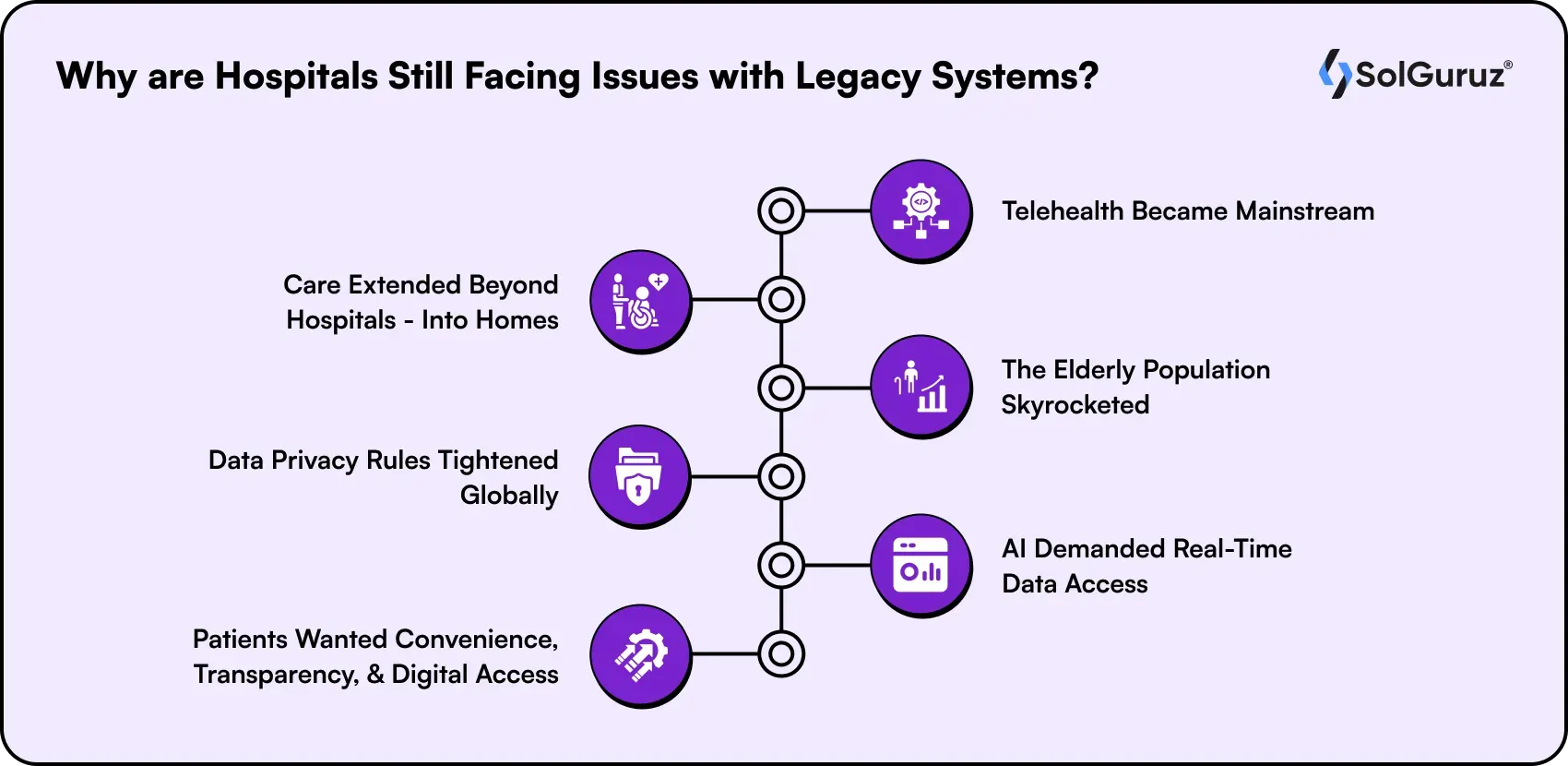
Why are Hospitals Still Facing Issues with Legacy Systems?
Most healthcare providers didn’t choose outdated systems; they simply inherited them.
A decade ago, many hospitals invested heavily in custom on-prem systems: HIS, EHR, radiology modules, lab workflows, billing, procurement, insurance… everything built rugged and “future-proof.”
Except the future showed up faster than expected.
Healthcare changed:
- Telehealth became mainstream
- Care extended beyond hospitals – into homes
- The elderly population skyrocketed
- Data privacy rules tightened globally
- AI demanded real-time data access
- Patients wanted convenience, transparency, and digital access
Legacy systems were never designed for this world.
Instead of helping, they now hold hospitals back:
- Simple tasks take 3 steps too many
- Systems crash when the load increases
- Integrations cost a fortune
- Data gets locked in silos
- Compliance becomes a headache
- Innovation becomes “maybe next year…”
Every delay in modernization → delays care, causes frustration, and increases risk.
Healthcare can’t afford inefficiency — not when decisions impact lives.
What Does Modernization Refer to in Healthcare?
It does not mean throwing away everything built so far.
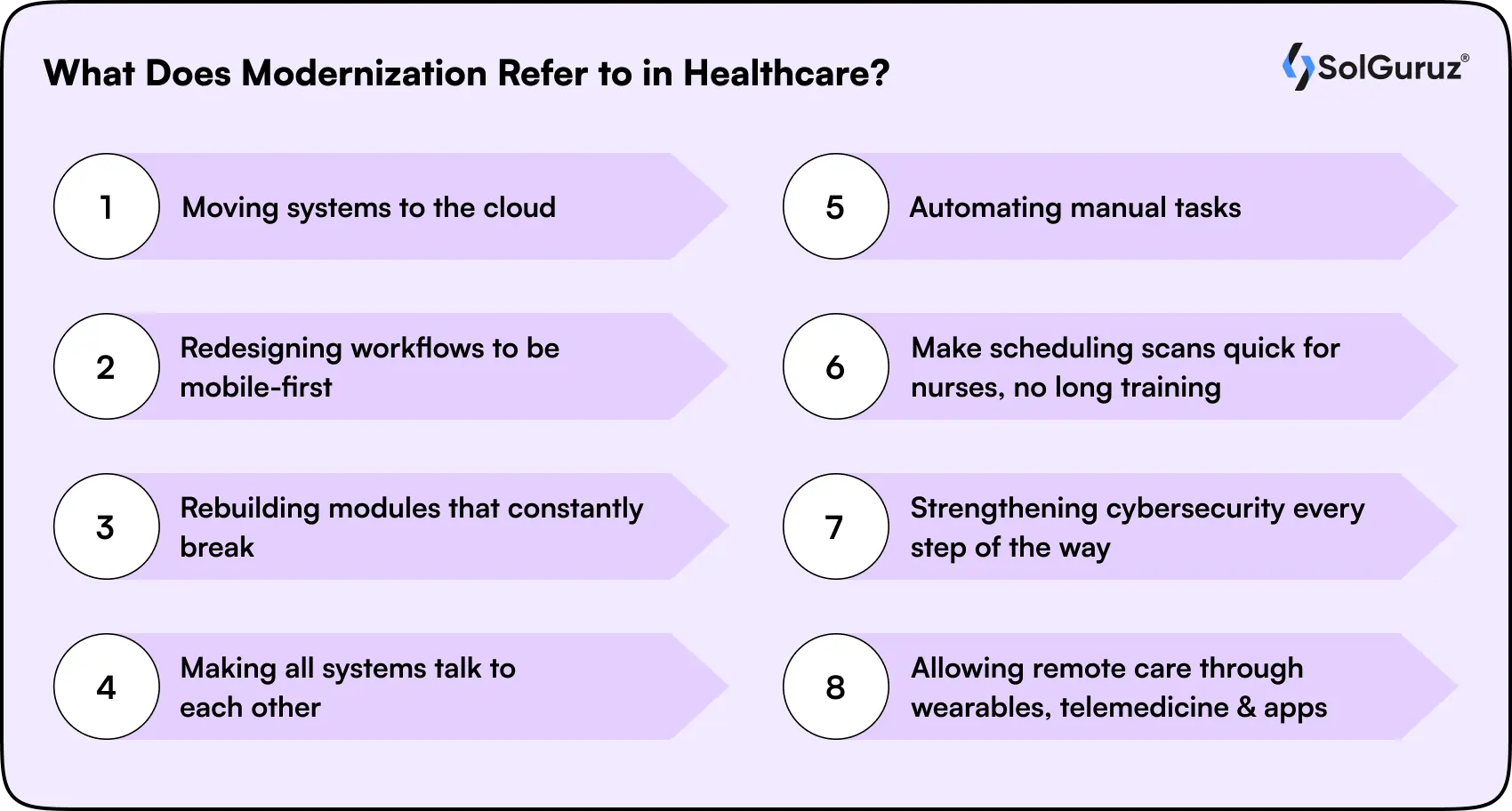
It means evolving existing systems so they can support modern healthcare expectations.
Modernization may include:
- Moving systems to the cloud
- Redesigning workflows to be mobile-first
- Rebuilding modules that constantly break
- Making all systems talk to each other (FHIR + HL7 APIs)
- Automating manual tasks
- Improving interfaces so nurses don’t need 2 hours of training to schedule a scan
- Strengthening cybersecurity every step of the way
- Allowing remote care through wearables, telemedicine, and apps
In simple words, I shall put it Like This >>
If software slows the care process → modernization makes it invisible.
If software blocks innovation → modernization opens doors.
Benefits of the Modern Healthcare System
When modernization is done well, the impact is not just technical — it’s human.
| Impact on People | Real-world result |
| Nurses save time on every record lookup | Patients get attended to faster |
| Doctors view the complete medical history instantly | Better clinical decisions |
| Elders access their reports easily | No hospital revisits for paperwork |
| Family caregivers stay informed | Reduced anxiety & better adherence |
| IT teams stop firefighting bugs | More time spent on innovation |
| Hospitals expand digitally | Telehealth, home-care, new revenue models |
Even the financial team breathes easier because modernization reduces maintenance costs, server loads, and IT downtime dramatically.
One of our partner clinics saw a 32% drop in operational costs just by updating their core appointment system and integrating payments.
Better care and better business no longer conflict; they complement each other through modernization.
Why Does Eldercare Demand Urgent Modernization?
Most legacy systems were built when healthcare happened inside hospitals.
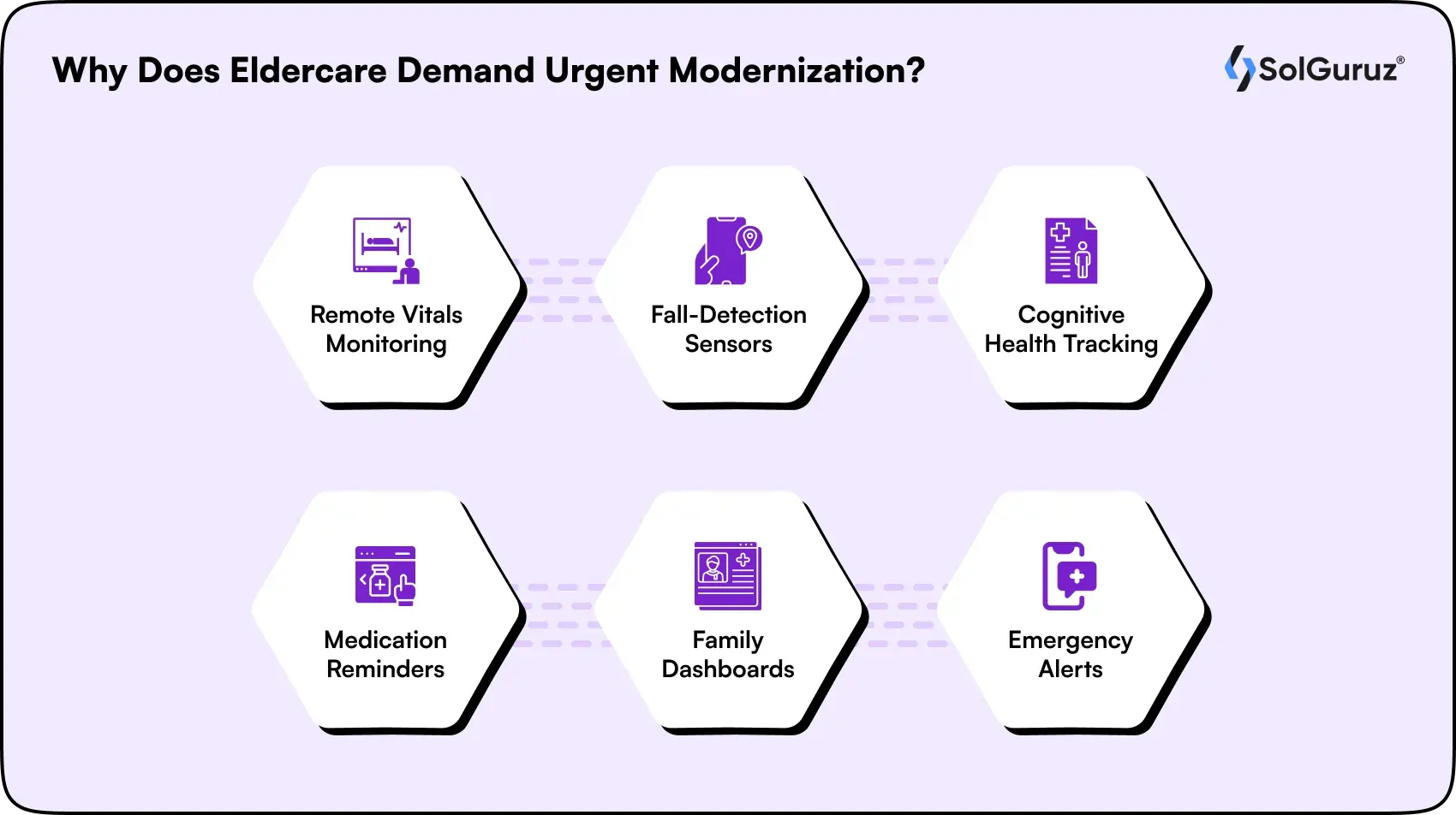
But today’s senior care depends on continuity:
- Remote vitals monitoring
- Fall-detection sensors
- Cognitive health tracking
- Medication reminders
- Family dashboards
- Emergency alerts
If the software behind these experiences is outdated, the risks amplify.
A 78-year-old shouldn’t struggle with logins or app overload.
Caregivers shouldn’t manually call to confirm a fall alert.
Doctors shouldn’t guess trends because data sits in isolated databases.
Modern software brings everyone into one connected circle of care.
“But modernization sounds risky…” (Let’s Clear the Myth)
This is the most common concern, and it’s valid.
Healthcare systems are mission-critical.
They can’t go down. Staff can’t be retrained overnight.
Medical records cannot go missing.
That’s why modernization must be planned like a medical procedure:
- Assess what must stay, what must evolve
- Modernize in phases, module by module
- Migrate data with validation cycles
- Run systems in parallel until 100% safe
- Provide hands-on training for smooth adoption
- Monitor success metrics after rollout.
Think of it as heart surgery while the heart keeps beating responsibly, skillfully.
Quick Overview on How Tech Supports Modern Healthcare!
Some modernization enablers we rely on:
- Cloud-native infrastructure
- FHIR-based interoperability
- HL7 integrations for lab & radiology
- RPA to automate repetitive admin work
- AI for predictions & decision support
- Zero-trust security + real-time monitoring
- Mobile-first UX for clinicians and patients alike
The end goal is always the same: Healthcare that feels fast, connected, and stress-free, not chaotic.
How does SolGuruz Calmly Support this Modernization Mission?
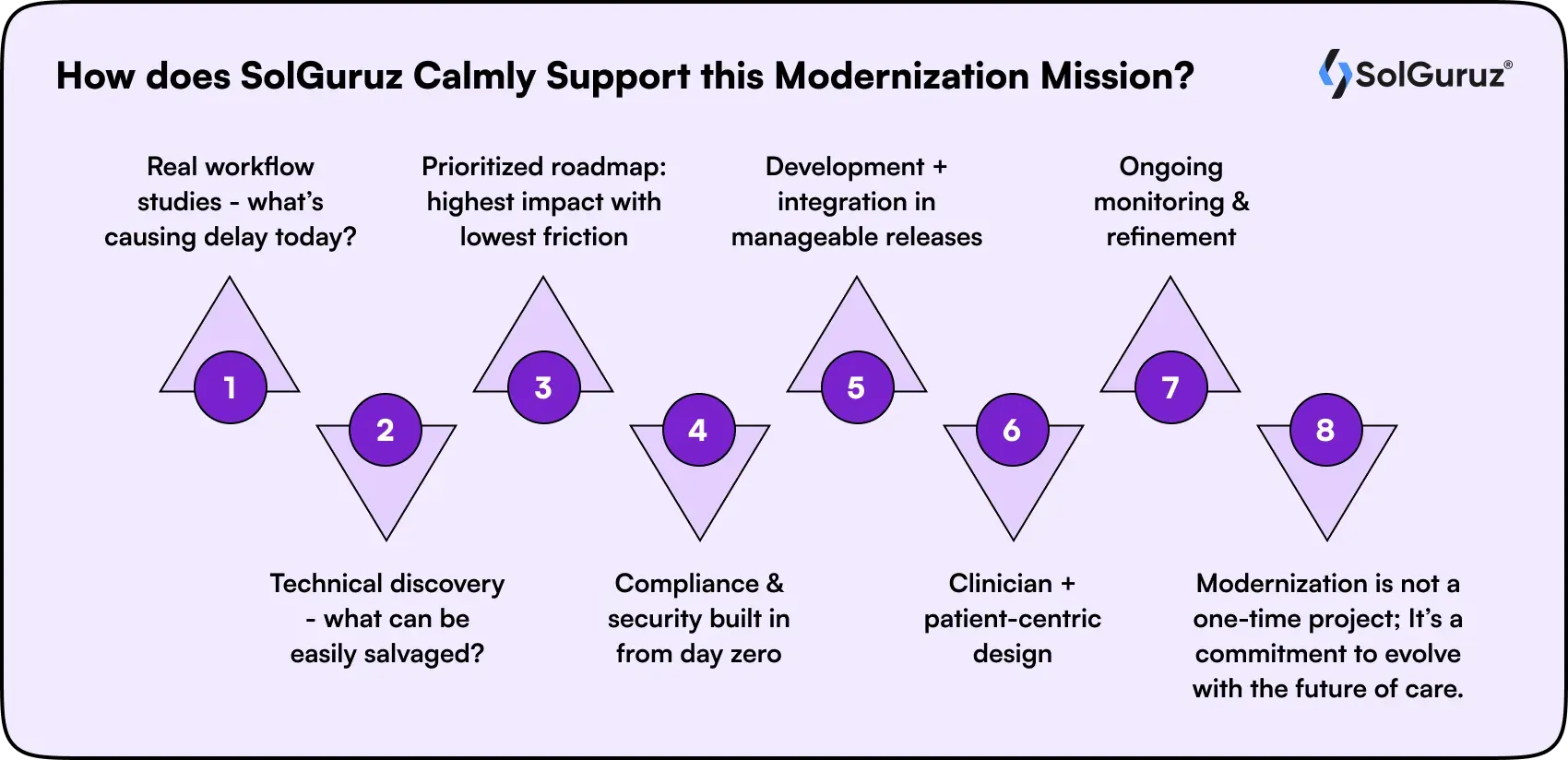
At SolGuruz, we approach modernization with a simple belief: first understand people, then upgrade machines.
As a healthcare software development company, we follow this process:
- Real workflow studies — what’s causing delay today?
- Technical discovery — what can be easily salvaged?
- Prioritized roadmap: highest impact with lowest friction
- Compliance & security built in from day zero
- Development + integration in manageable releases
- Clinician + patient-centric design
- Ongoing monitoring and refinement
- Modernization is not a one-time project; It’s a commitment to evolve with the future of care.
Final Thought
Healthcare isn’t optional. Care must be faster than fear, and technology should never become a reason for delay.
Modernization isn’t about software. It’s about protecting trust, supporting clinicians, and giving every patient — especially seniors — the dignity of smooth care.
FAQs
1. Does Modernization Feel like an Interruption to Regular Hospital Operations?
Not when done right. We design phased rollouts so your care workflows never stop.
2. What About Data Loss While Adapting to Healthcare Modernization?
We conduct backups, sandbox migrations, and staged validations to ensure zero data compromise.
3. Can My Small Clinic Also Adapt to Healthcare Modernization?
Absolutely. Smaller providers see the fastest ROI and satisfaction boost.
4. Does EHR Refer to Healthcare Modernization?
If it’s slowing you down, blocking integrations, or causing user frustration — yes.
5. What Compliance Does Modernization Support in Healthcare?
Yes, along with HIPAA, GDPR, and region-specific healthcare data laws.