Most health apps are built for the masses.
Which means they fail to track the things women actually want clarity on.
This includes symptoms, hormonal changes, plus long-term wellness insights.
This is exactly why women-focused health-tracking apps have become one of the fastest-growing segments.
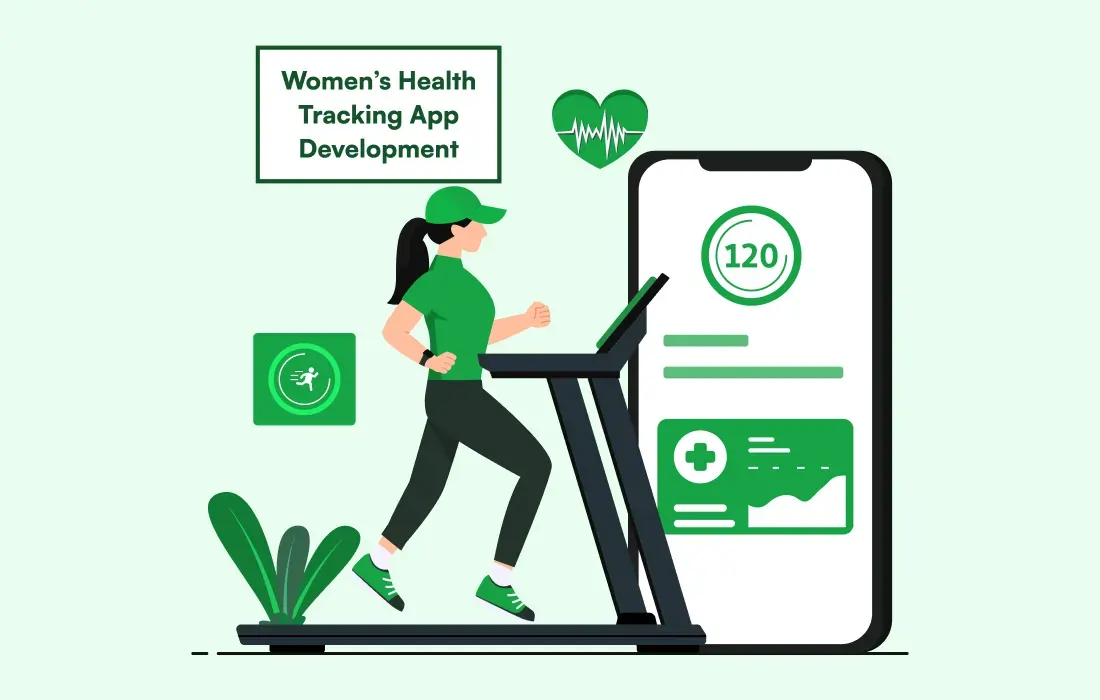
This guide walks you through the market demand + process of a women’s health tracking app development.
I will also drop a feature checklist and the cost of building such an app.
Why Is There a Demand for a Separate Health Tracking App for Women?
Most of the so-called “health tracking apps” in the market still behave like glorified step counters with a calendar slapped on top.
Anyone who has ever worked closely with women users (or even observed real app usage patterns) knows this.

Women don’t just want to log their health; they want an app that understands why things are changing, what to expect next, and how it connects to the rest of their daily life.
When we built and tested health features for different user segments, one thing became obvious quickly.
Women’s health data doesn’t follow a neat, predictable line. It moves in cycles, in patterns, in phases.
A generic tracker simply cannot make sense of that rhythm. And women feel that gap immediately.
Below is the real reason dedicated apps are winning.
1. Generic Health Apps Don’t Reflect Real Women’s Patterns
Talk to any woman who has tried using a standard health app. The first complaint is almost always the same:
“It tells me what should happen, not what is happening.”
Cycle length varies. Symptoms vary. Mood patterns shift. Energy levels fluctuate. And none of this is linear.
When we analysed user logs, the missing context in general apps was shocking. Women were basically trying to fit a dynamic health cycle into a static template. That doesn’t work.
A women-focused app solves this by making the pattern itself the core of the product.
2. There Is a Massive Behaviour Shift
Earlier, most tracking was manual or ignored. Now women track: cycle irregularities, sleep dips, PMS severity, cravings, cramps, stress impact, fertility signs, PCOS glitches.
This isn’t hype. It’s a behaviour change.
And when users become more aware, they look for tools built specifically for their needs, not adjustable templates. General apps feel outdated in comparison.
3. Femtech Grew Because Mainstream Tech Never Served These Needs
When you build for “everyone,” you end up building for no one.
That’s exactly what happened with women’s health.
If you look at femtech’s rise closely, it wasn’t led by brands. It was led by users who kept asking for:
- Better cycle intelligence
- Better fertility prediction
- Better symptom explanations
- Better guidance during pregnancy and postpartum
- Better support during perimenopause and menopause
Mainstream health apps simply never addressed this depth.
Women turned to specialised apps because that’s where the real solutions were.
4. Privacy Matters More Here Than in Any Other Health Segment
Nothing reveals how personal this category is more than user behaviour around privacy settings.
Women want to know:
- Who has access?
- How is data stored?
- What’s anonymised?
- Who controls deletion?
Once you deal with real women’s health data, you learn quickly: Trust is the product.
A dedicated app can prioritise privacy at a level that general wellness apps don’t bother with.
5. Personalization Is the Minimum Expectation
In women’s health, personalization is a baseline.
When we analysed user feedback, we saw comments like:
- “Tell me what my logs mean, not what happens to ‘most women’.”
- “I don’t want averages. I want my pattern explained.”
A dedicated women’s health app can adapt to age, lifestyle, and more. Generic apps cannot go this deep.
6. The UX Needs Are Completely Different
Anyone who has ever designed UX for women’s health knows this: tone matters. A lot.
You can’t make a cycle tracking screen feel like a gym membership dashboard.
You can’t show symptom inputs, such as a weight log.
You can’t send aggressive push notifications about fertility. And you definitely can’t design sensitive flows as if they were task managers.
Dedicated apps succeed because they treat the experience with care, empathy, and context, without being patronizing.
How to Develop a Women’s Health Tracking App?

If you’ve never built a women’s health product before, here’s the first thing you need to understand. This is not “just another health app.”
The healthcare development approach can’t be copied and pasted from fitness apps, generic trackers, or wellness dashboards.
Women’s health has its own behaviour patterns, data model, and UX language.
If you treat it like a normal development project, the app will end up feeling shallow, inaccurate, or outright useless to the user.
Here’s the development process, the way teams who actually build strong women’s health apps approach it.
1. Start With the Specific Use Case
Most founders jump into “let’s build period tracking + symptoms + fertility + reminders” all at once.
That’s a mistake.
Women’s health is a broad category. You need to decide what your product is really solving.
Are you building for:
- Cycle tracking?
- Fertility awareness?
- PCOS/PCOD management?
- Pregnancy and prenatal care?
- Postpartum support?
- Perimenopause or menopause?
Each segment has a completely different user journey, data model, and prediction layer.
If you try to do everything, you’ll end up doing nothing well.
2. Build a Real Data Model Before You Write a Single Line of Code
Women’s health apps are prediction engines at their core.
You cannot just create “Day 1, Day 2, Day 3…” and assume it works.
You need:
- Cycle variability logic
- Symptom correlations
- Hormonal phase mapping
- Long-term pattern detection
- Anomaly detection (for irregular cycles)
- Fertility window calculations
- Prediction dampening for inconsistent logs
The biggest difference between a mediocre tracker and a great one is the data engine, not the UI.
If you don’t architect this early, your app will forever feel inaccurate.
3. Design the UX With Sensitivity and Context
Women log deeply personal data. Some of it is sensitive, some confusing, some emotional, some medical.
Your UX needs to:
- Avoid clinical, robotic wording
- Avoid “cheerleader” tone
- Avoid judgmental microcopy
- Avoid pushy notifications
- Avoid dumping charts everywhere
Instead, focus on:
- Clean inputs
- Warm but neutral tone
- Contextual suggestions
- Pattern summaries
- Insights that answer “why this matters.”
One wrong UX tone and you lose the user, regardless of how accurate your engine is.
4. Build the Core Features First, Not the Fancy Ones
The non-negotiables usually include:
- Cycle tracking
- Symptom logging
- Prediction engine
- Insights dashboard
- Reminders
Everything else (AI chatbots, community, premium content, telehealth, wearable sync) can come later.
Founders who try to launch with a “super app” usually burn time, money, and dev bandwidth for nothing.
Launch a sharp, focused version first.
5. Prioritize Privacy Architecture as a Core Module
This is not like building a calorie counter. Women expect absolute control over their data.
You need to bake in:
- End-to-end encryption
- Local storage options
- Clear opt-ins
- Consent-driven data sharing
- Transparent data explanations
- A “Delete All Data” button that actually works
Trust isn’t a USP here. It’s the backbone.
6. Build Accurate Predictions, Then Layer Personalization on Top
Your app can’t just say: “Your period starts in 28 days.” That’s generic and useless.
You need:
- Adaptive predictions
- Cycle-to-cycle recalibration
- Symptom-based adjustments
- Anomaly handling
Once that works, add personalization like:
- Lifestyle-based suggestions
- Contextual insights
- Forecast scenarios (“Your cycle may come 1–2 days earlier this month”)
- Personalized content for each stage
This is what makes users stay.
7. Test With Real Women Users, Not PMs and Developers
This is the most important and most ignored step.
A real women’s health app only becomes accurate when you test it with:
- Women with regular cycles
- Women with irregular cycles
- PCOS users
- Women on birth control
- Women in their 30s–40s
- Postpartum users
- Perimenopause users
Each group logs differently, interprets differently, and expects different insights.
Internal testing is meaningless in this category.
8. Plan Iterations Based on Behaviour + Feedback
Women won’t always say what’s wrong with the app. But behaviour reveals it:
- If symptom logging drops, the inputs are too many.
- If predictions are skipped, accuracy is off.
- If retention dips before the period week, the insights aren’t useful.
- If onboarding drop-off is high, you’re asking too many questions.
This is a category where hard data is more honest than surveys.
What are the Must-Have Features in a Women’s Health Tracking App

Here’s the mistake most founders make: they look at top apps, list all features, and try to copy everything.
But once you study real user behaviour (and not what product teams think users do), you notice something very clear.
Women consistently rely on a small set of core features. The ones that make the app feel accurate, personal, and trustworthy.
Everything else is just decoration.
Here are the features that actually matter. I have explained them with context + product logic.
1. A Cycle Tracking Core That Actually Adapts
Most cycle trackers still use a rigid 28-day template and simply adjust a few days here and there.
That’s why users complain the predictions feel “off.”
Your tracker needs:
- Variable cycle length handling
- Automatic recalibration after each new log
- Anomaly detection (late cycles, skipped cycles)
- Dynamic prediction windows
- Phase mapping that isn’t copy-paste for every user
A good tracker doesn’t ask users to fit into a pattern. It builds the pattern around them.
2. Symptom Logging That’s Fast, Clean, and Doesn’t Feel Like Homework
Real users don’t want 40 symptoms to scroll through. Nor do they want medical jargon.
The best logging experiences follow a rule: low effort, high clarity.
Your app should offer:
- The few symptoms that matter daily
- Expandable options for depth when needed
- Simple scales (light–medium–heavy)
- Visual cues instead of paragraphs
If logging feels like filling a form, users will stop.
3. A Prediction Engine That Feels ‘Intelligent.’
Women don’t want generic statements. They want intelligent, personalised insights that reflect real patterns.
Examples:
- “Your period may come 1–2 days earlier based on last month.”
- “Your PMS symptoms often start 3 days before your period.”
- “Your energy levels dip in this phase; adjust your workouts.”
These insights create retention. They make the app feel like it “gets” them.
4. A Clean, Non-Overwhelming Daily Dashboard
A women’s health app should not look like a trading chart.
The best dashboards show only what matters today:
- Current cycle phase
- Predicted symptoms
- Lightweight insights
- Reminders or action items
- Trends that actually help, not clutter
The user should understand her day at a glance.
5. Privacy Controls That Build Immediate Trust
This category has zero room for ambiguity around data.
Your app must have:
- Clear data permissions
- Encrypted logs
- Easy data export
- One-tap account deletion
- Transparent privacy copy (no hidden policy tricks)
Women share deeply personal health details. The app must earn that trust continuously.
6. A Gentle, Contextual Reminder System
Push notifications can easily feel intrusive or tone-deaf.
Instead of robotic reminders like: “Log your period today.”
Use contextual nudges: “Your expected start date is close. Any updates you want to add?”
Reminders should feel supportive, not demanding.
7. Insights That Explain Patterns, Not Just Show Charts
Charts mean nothing if they don’t tell the user what they’re seeing.
Your insights module should break down:
- Cycle trends
- Symptom trends
- Mood correlations
- Sleep and energy patterns
- Recurring anomalies
More importantly, it should explain why these patterns matter. In simple language, not medical heavy talk.
8. Support for Different Life Stages
Women’s health isn’t the same from 16 to 46. Your app should adapt to different journeys:
- Teens
- Irregular cycles
- PCOS/PCOD
- Birth control
- Trying to conceive
- Pregnancy
- Postpartum
- Perimenopause
A one-track app falls apart the moment a user’s life stage changes.
9. Optional Add-Ons
These are features you build after you are sorted with basic features and functionalities.
- AI-driven health assistant
- Telehealth integration
- Wearable sync
- Community spaces
- Guided programs (sleep, mental health, nutrition)
- Premium content or personalization layers
These are valuable, but only when your core engine is strong.
What is the Cost to Develop a Good Health Tracking App for Women
It ain’t easy to give an estimate. But broadly, every woman’s health app falls into one of these tiers:
| App Type | What It Includes | Estimated Cost (USD) |
| Basic Women’s Health Tracker | Cycle tracking, symptom logging, simple predictions, basic dashboard | $10,000 – $25,000 |
| Mid-Level App | Adaptive prediction engine, advanced symptoms, smart insights, privacy layer, onboarding personalization | $35,000 – $60,000 |
| High-End Femtech App | AI insights, multiple life-stage support, wearable sync, premium UX | $70,000 – $150,000+ |
Here’s the breakdown of the cost:
- Product Strategy & UX: 15–20%
- Prediction/Data Engine: 20–30%
- Frontend + Backend Dev: 40–50%
- QA + Testing: 10–15%
- Security & Privacy Layer: built throughout, not optional
How Can SolGuruz Help You With Women’s Health Tracking App Development
If you’re planning to build a women’s health tracking app, you need a team that understands two things clearly.
The complexity of women’s health data and the product sensitivity this category demands.
At SolGuruz, we’ve worked on health, wellness, and data-intensive apps that rely on accurate tracking, predictive logic, and a privacy-first architecture.
Our approach is simple. We build fast and stable products.
And if you need help, our team can help you take it from idea → UX → development → launch.
FAQs
1. How accurate can predictions really get?
Accuracy depends on your data model. Apps with dynamic cycle-learning, symptom correlations, and continuous recalibration become highly accurate over time. Static 28-day templates are what make predictions feel “off.”
2. Can AI improve women’s health tracking apps?
Yes, but only when the core data engine is strong. AI works best for:
- Personalised insights
- Symptom pattern recognition
- Anomaly detection
- Lifestyle-based recommendations
3. How long does it take to build a women’s health tracking app?
A basic version takes 2-4 weeks. If it’s a mid-level app, you might need 5-10 weeks. And for high-end femtech platforms, it can take 12–18+ weeks.
4. How do women typically use these apps daily?
Usage is simple and consistent:
- Quick symptom logs
- Checking cycle phase
- Viewing predictions
- Reading short insights
- Using reminders
A good UX keeps daily usage under 1 minute.
5. Can a small startup compete with big femtech apps?
Absolutely, but only by specialising. Big apps try to serve everyone. The fastest-growing femtech products win by going deep into one problem and solving it better than anyone else.